You’ll find one of Europe’s best-kept Art Deco secrets tucked away in northern France.
Saint-Quentin isn’t just another pretty French town—it’s an open-air museum where entire streets showcase the bold geometric lines and vibrant materials that defined the 1920s. After World War I devastated three-quarters of the city, architects transformed destruction into opportunity.
What they created is something you won’t see anywhere else, and here’s why it matters for your next trip.
- Saint-Quentin rebuilt 75 percent of its city in Art Deco style between 1922 and 1929 after WWI destruction, creating one of Europe’s finest Art Deco collections with over 3,000 facades
- The Palais de l’Art Déco hosts exhibitions through September 2025, open Tuesday through Sunday, 2pm to 6pm, with admission at €8 (€5 reduced)
- You can explore five major Art Deco landmarks including the Hôtel de Ville’s hidden 1924 Council Chamber, the Grande Poste’s interlacing brick patterns, and the Casino Cinema’s carnival-head façade
- Guided tours of the Hôtel de Ville’s interiors must be booked through the tourist office to see Louis Guindez’s glazed coffered ceiling and 37-bell carillon
- Spring’s Printemps Art Déco festival and golden-hour photography sessions in early morning or late afternoon provide the best times to capture the city’s geometric patterns and decorative details
- The city’s architects deliberately chose durable materials like red brick, colored mosaics, forged iron, and stained glass rather than mass production to create resilient structures
- Self-guided walking tours through the reconstructed town center reveal geometric patterns, wrought iron railings, and colorful mosaics on nearly every street façade
Top Art Deco Buildings You Must See in Saint-Quentin
Saint-Quentin’s Art Deco treasures tell a remarkable story of rebirth and resilience. You’ll find extraordinary buildings that rose from WWI destruction between 1922 and 1929.
Start at the Palais de l’Art Déco, a former department store with stunning wrought iron railings and painted stucco. It’s one of France’s finest Art Deco examples. The palace hosts exhibitions celebrating the town’s Art Deco heritage through September 2025.
Next, visit the Hôtel de Ville. While its Gothic exterior dates to 1509, step inside to discover Louis Guindez’s 1925 Municipal Council Chamber with custom wood paneling.
Don’t miss the Gare de Saint-Quentin’s Buffet, built in 1926 with ceramic mosaics and Venetian enamel. The Conservatoire de Musique showcases Flemish-influenced Art Deco from 1929.
Finally, check out the Poste Centrale’s red brick patterns and Cubist mosaics—pure Roaring Twenties elegance.
Why Three-Quarters of Saint-Quentin Was Rebuilt in Art Deco?
The catastrophic destruction of World War I left three-quarters of Saint-Quentin in ruins, but it also created an extraordinary opportunity. Germany’s reparation payments flooded the town with reconstruction funds just as the bold, modern Art Deco movement was sweeping through France in the 1920s.
You’re looking at a city that literally rose from the ashes in the style of its era—turning wartime devastation into one of Europe’s most stunning Art Deco showcases. The Palais de l’Art Déco, formerly the central post office, now serves as a museum celebrating this architectural renaissance.
WWI Destruction and Reparations
When German forces seized Saint-Quentin in 1914, nobody could’ve imagined the catastrophe that would unfold over the next four years. The occupiers stripped your textile mills bare, shipped locals off for forced labor, and transformed your town into their Second Army headquarters.
By 1917, they’d evacuated everyone to fortify the Hindenburg Line. The real devastation came in October 1918.
As German forces retreated, they systematically dynamited Saint-Quentin street by street. Three-quarters of your city lay in ruins—part of 620 municipalities completely destroyed across northern France.
The numbers tell the story: 293,043 buildings razed, 34 billion gold francs in regional damages. Even your Gothic basilica barely survived German explosives. That’s why you’d need to rebuild nearly everything from scratch.
The Commission for Relief in Belgium had worked throughout the occupation to prevent starvation, distributing food funded by international donations and grants.
Roaring Twenties Aesthetic Choice
As your devastated city faced reconstruction in the early 1920s, Art Deco wasn’t just an aesthetic choice—it was a declaration of faith in the future. You’ll find three-quarters of Saint-Quentin rebuilt in this bold style, transforming the city into a living laboratory of post-war innovation.
The style perfectly captured the Roaring Twenties spirit—streamlined curves, geometric patterns, and gleaming materials like bronze, stainless steel, and marble. You’re seeing purity of form meeting reinforced concrete, breaking decisively from the past.
The movement took its name from the 1925 Exposition Internationale des Arts Décoratifs et Industriels Modernes held in Paris.
But here’s what made it lasting: craftsmen avoided mass production, favoring personalized French-made pieces with solid classical proportions. Each building—from the flamboyant Casino cinema to the Cubist-mosaic post office—was designed to endure generations. This wasn’t temporary reconstruction; it was nation-building through architectural resilience.
Palais De L’art Déco: Inside the Former Post Office Museum
You’ll discover Saint-Quentin’s Art Deco soul at the Palais de l’Art Déco, a stunning former department store that’s now an exhibition hall showcasing the city’s architectural rebirth. Step inside the grand hall at 14 rue de la Sellerie, where painted stucco decorations and wrought iron railings frame one of France’s finest Art Deco interiors.
The building’s ‘Commerce’ medallion, carved by sculptor Raoul Josset, hints at the craftsmanship waiting inside—from neo-Gothic metal and glass details to intricate vignettes that’ve survived decades of abandonment.
Restored Historic Postal Interiors
The grandeur of Art Deco design greets you the moment you step inside this former department store, where soaring ceilings and elegant balconies showcase the movement’s signature blend of luxury and geometry. You’ll find intricate wrought iron railings curving along multiple levels, their interlacing patterns perfectly preserved.
The painted stucco decorations still adorn the walls, demonstrating the era’s commitment to ornamental detail. The reinforced concrete structure reveals 1920s modernist construction at its finest.
Every element reflects the Roaring Twenties’ prosperity, when Saint-Quentin spared no expense rebuilding after WWI’s devastation. Though the shops closed long ago, the ground floor now operates as an exhibition space. You can explore these restored interiors and appreciate how the architects merged clean lines with decorative flourishes—creating timeless elegance.
Museum Exhibits and Collections
Celebrating its centennial anniversary, Art Deco comes alive inside the Palais de l’Art Déco with the exhibition “Elegance and Modernity. Art Déco is 100 years old!” You’ll explore over 300 works showcasing the movement’s incredible diversity and cultural impact. The museum sits at 14 rue de la Sellerie, accessed through Espace Saint-Jacques where the Chamber of Commerce once stood. This Neo-Gothic building from 1927 is itself an architectural gem.
Visit Tuesday through Sunday, 2pm to 6pm, until September 21, 2025. Admission costs €8 (€5 reduced rate), but it’s free if you’re under 18 or a Saint-Quentin resident.
Don’t miss the complementary tribute to Gaston Suisse at Musée des Beaux-Arts Antoine Lecuyer, highlighting this painter-decorator’s Art Deco legacy.
Architects Behind the Design
Behind every stunning Art Deco facade stands a visionary architect who dared to reimagine Saint-Quentin after World War I’s devastation.
- Sylvère Laville — designed the Nouvelles Galeries in 1922 with striking glass towers that preceded the famous 1925 Paris Exposition
- Louis Guindez — municipal architect who transformed the Council Chamber’s interior in 1924 and created the poisson market building in 1928 with pergolas evoking Roman baths
- Jean Charavel — brought Marseille’s expertise after winning the Roupy competition in 1922
- Paul Bigot — shaped the 1919 urban reconstruction plan for the entire city center
- Gustave Umbdenstock — delivered the reconstructed railway station by 1926
Hôtel De Ville’s Hidden Art Deco Rooms and 37-Bell Carillon
Stepping through Saint-Quentin’s Hôtel de Ville feels like entering two different worlds at once. The flamboyant Gothic exterior from 1509 conceals stunning Art Deco interiors that’ll take your breath away. After World War I destroyed 70% of Saint-Quentin, architect Louis Guindez transformed the Council Room and halls with bold Art Deco designs in 1924. The former Audience Room—where royal officers once held court—now showcases modern decoration beneath its preserved Gothic roof.
You’ll discover 173 ornamental statues adorning the façade, but the real treasure sits above. The bell tower houses a magnificent 37-bell carillon that punctuates daily life with musical performances. This fusion of medieval grandeur and 1920s innovation represents Saint-Quentin’s remarkable spirit—honoring its past while embracing modernity.
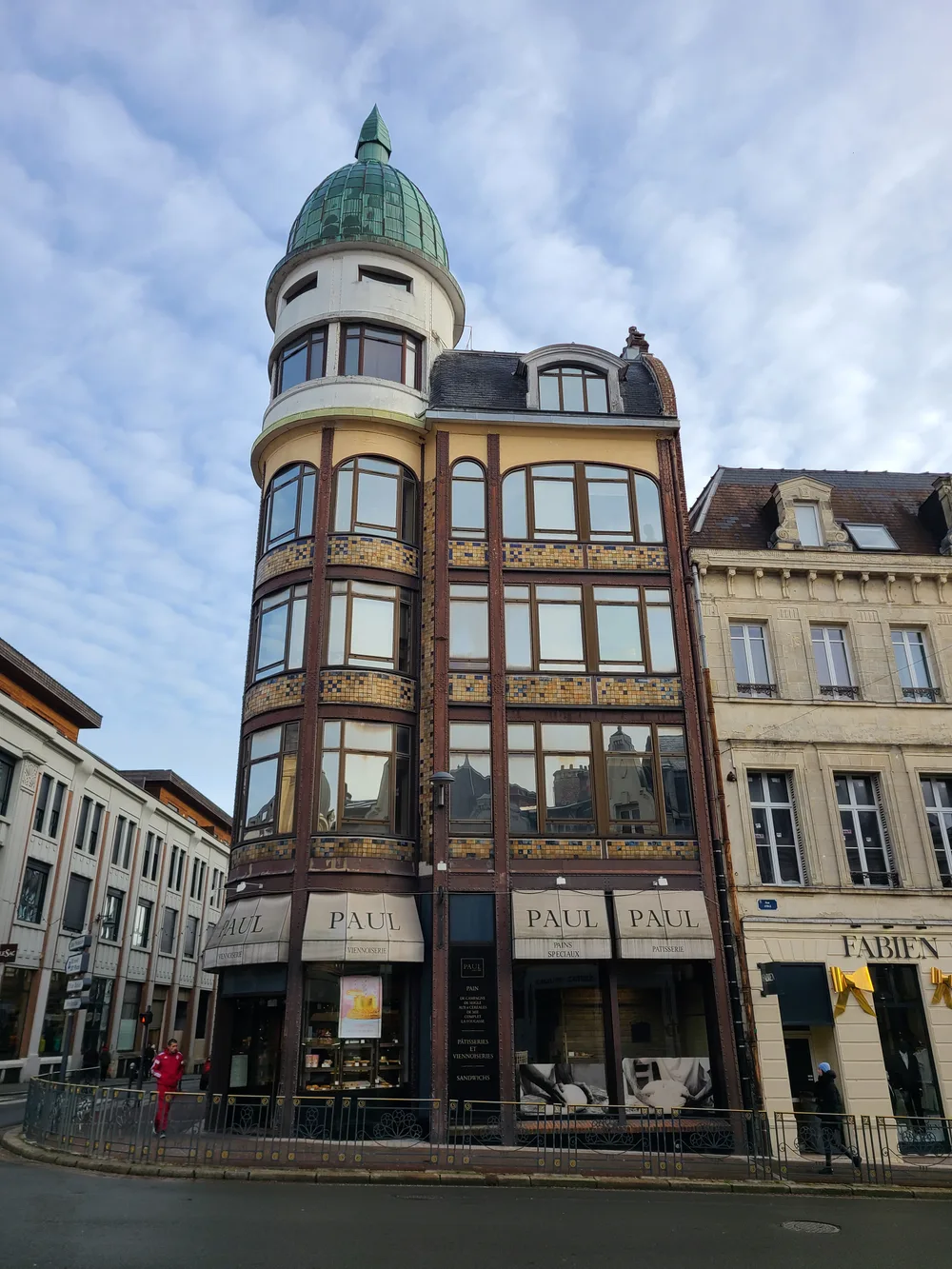
Grande Poste and Its Interlacing Brick Patterns
Rising from the birthplace of celebrated painter Maurice Quentin de La Tour, the Grande Poste commands attention with its 1929 Art Deco magnificence. Architect René F. Delannoy created this reinforced concrete masterpiece near the Basilica as part of Saint-Quentin’s post-WWI reconstruction.
You’ll immediately notice the interlacing brick friezes arranged in gear-tooth patterns across the façade. These geometric designs wrap around lateral pavilions and the central attic level, creating striking visual rhythms. The brickwork contrasts beautifully against thick, smooth concrete cornices.
Step closer to admire the forged iron marquise above the glass and metal entrance. Spiral motifs add elegance to this streamlined design. The building perfectly balances bold geometric patterns with intricate detailing, showcasing Art Deco’s marriage of modern construction techniques and classical proportions.
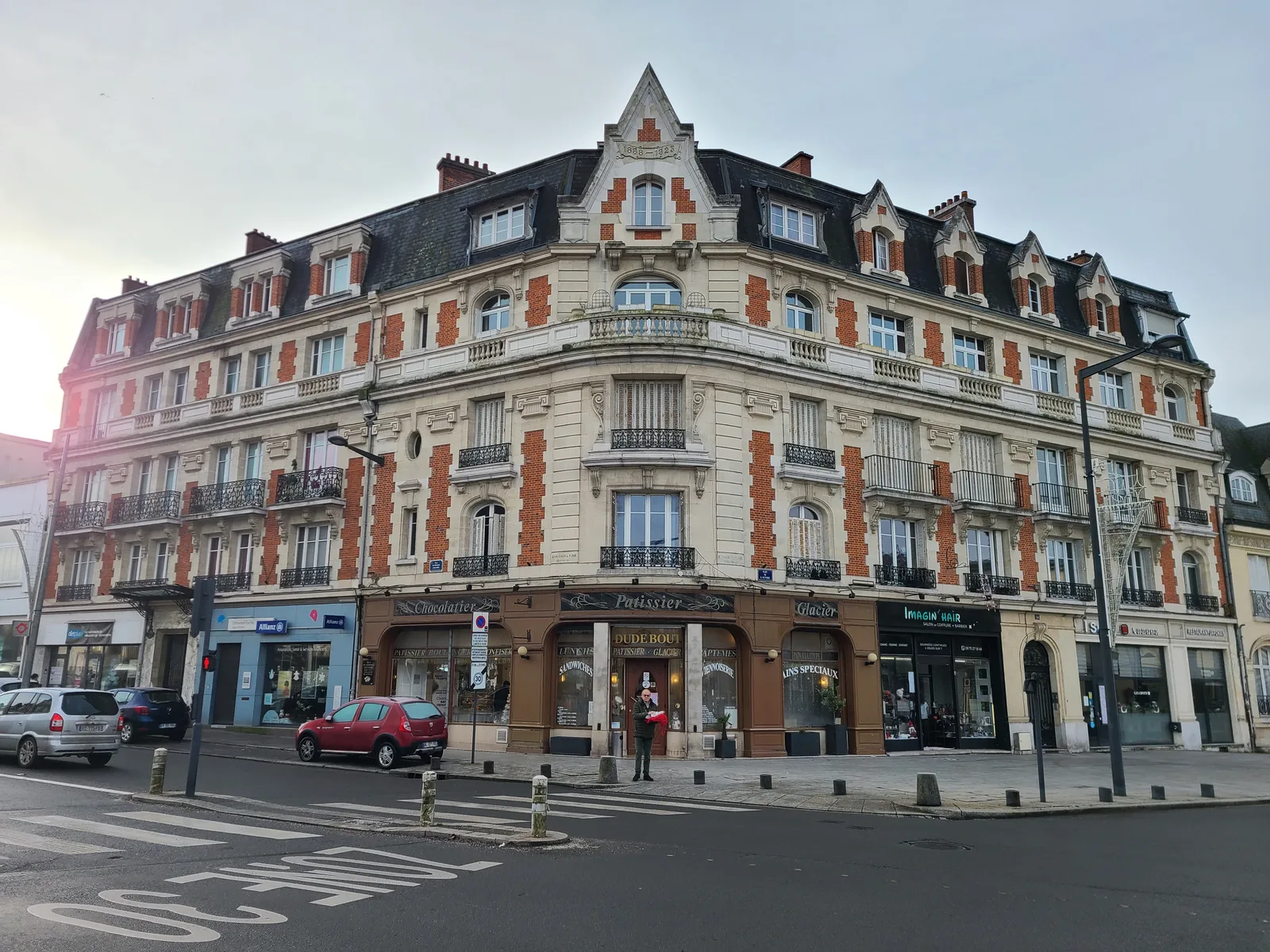
Art Deco Stained Glass in Basilique Saint-Quentin
You’ll discover a stunning contrast when you step inside the Basilique Saint-Quentin—Art Deco windows from the 1930s share space with medieval glass panels that survived centuries of warfare. Georges Bougeot’s 1931-1932 “Tumbling Roses” design brings a fresh, geometric twist to traditional religious imagery, particularly in his Holy Communion window on the south side. This blend of 12th-century blue depths and 20th-century angular patterns creates an unexpected visual conversation between two distinct artistic eras.
Tumbling Roses Window Design
Created during post-World War I restoration efforts, the window showcases how Saint-Quentin’s glassmakers embraced modern aesthetics while honoring medieval craftsmanship. The tumbling roses cascade dynamically across the glass, filtering light through brilliant hues that transform the chapel’s atmosphere.
You’ll find this window in one of two chapels, where it contrasts beautifully with its companion featuring autumnal tones. Together, they represent Saint-Quentin’s commitment to blending historic reverence with Charleston-era vibrancy, making the basilica a remarkable destination for Art Deco enthusiasts.
Blending Medieval and Modern
When you step inside the Basilique Saint-Quentin, you’ll witness an extraordinary dialogue between centuries. Georges Bougeot’s Art Deco stained glass windows from 1931-1932 sit comfortably alongside medieval glass dating back to the 12th century. You’ll find his Holy Communion window and Saint Thérèse panel in the northern side nave, their streamlined curves and geometric patterns complementing the Gothic architecture rather than clashing with it.
The post-WWI reconstruction team made bold choices. They integrated over 3,000 Art Deco elements throughout Saint-Quentin, including these basilica windows. Master Grüber’s deep blue restorations and Auguste Labouret’s transept designs bridge the gap between old and new. You’ll see how brick, stone, and forged iron unite different eras, creating something uniquely Saint-Quentin.
Casino Cinema and Le Carillon: 1920s Entertainment Architecture
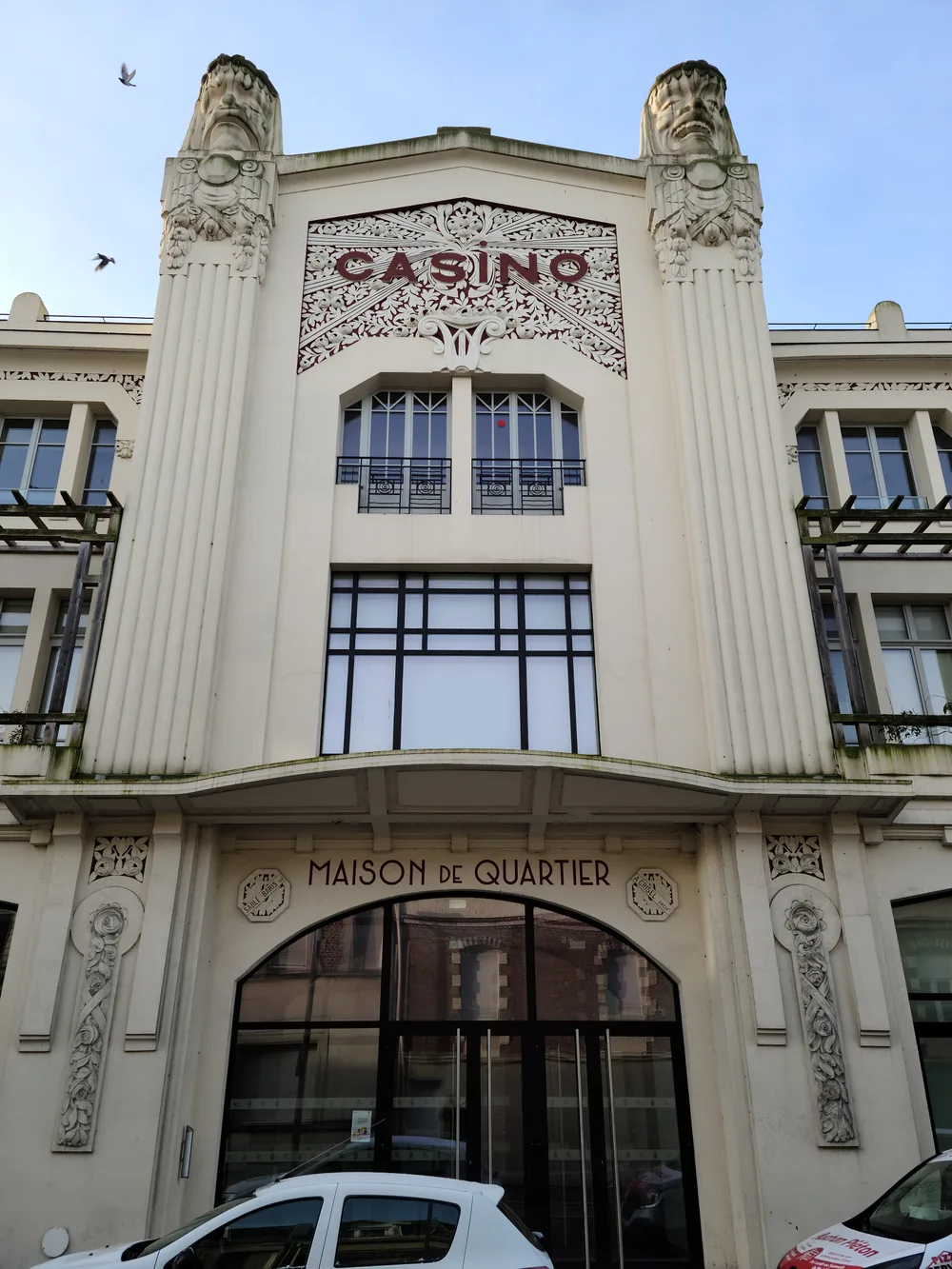
The Casino Cinema exploded onto Saint-Quentin’s entertainment scene on 29 June 1929, instantly becoming the region’s largest and most glamorous venue. Architect Adolphe Grisel designed this 1270-seat marvel as a cinema, music-hall, dance hall, and salle des fêtes all rolled into one.
- Monumental pilasters crowned by gigantic carnival heads — depicting comedy and tragedy masks, nicknamed “Jean qui rit” and “Jean qui pleure” by locals
- Stylised roses in moulded cement — a signature Art Deco motif throughout the façade
- Bold geometric patterns — featuring aerodynamic curves, abstract designs, and feathered details
After two years of restoration, it reopened as the Maison de Services à la Population. Along with Le Carillon, these buildings showcase Saint-Quentin’s extraordinary collection of 3000 Art Deco facades that earned the town its Ville d’Art et d’Histoire status.
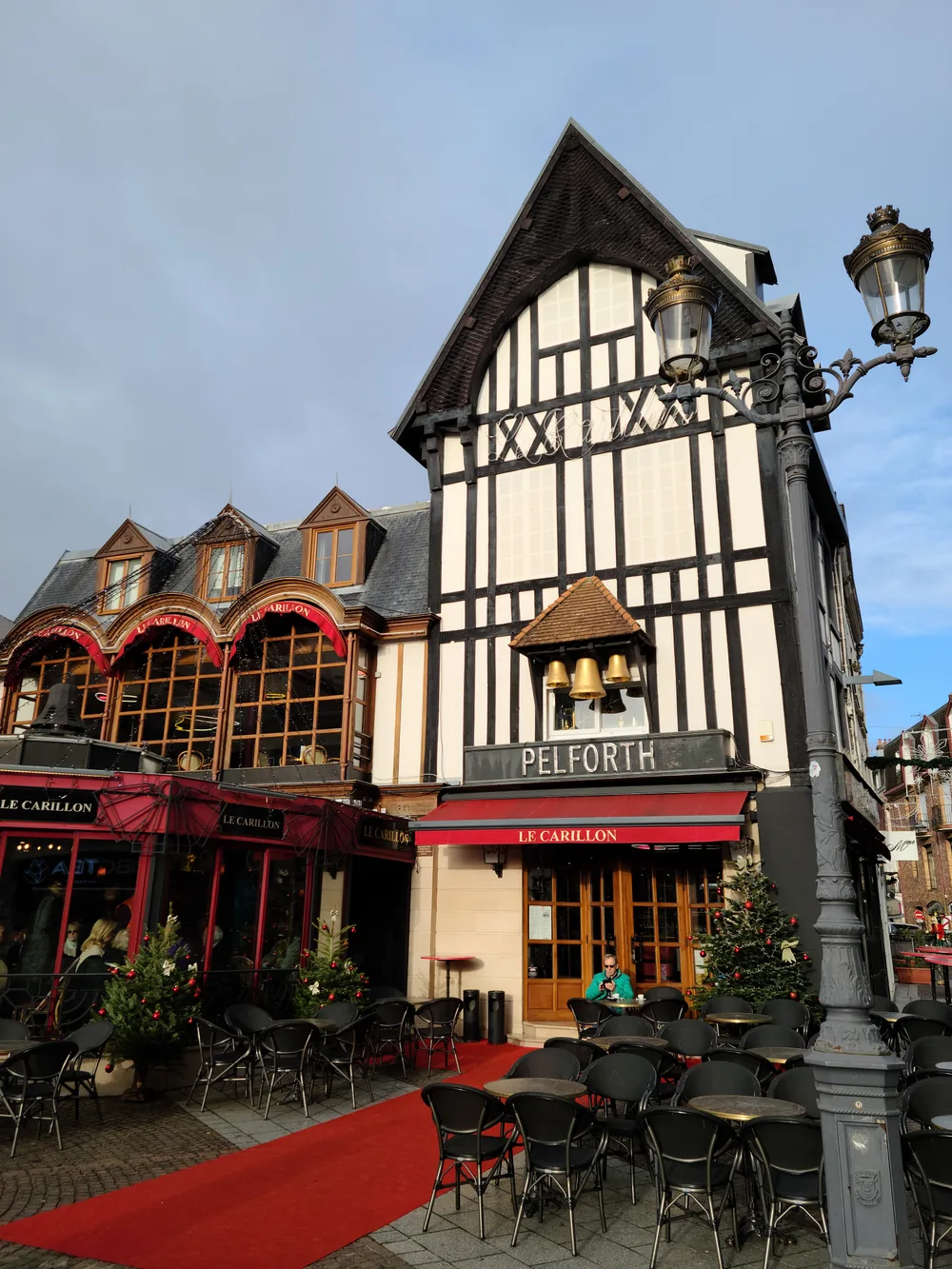
Street Facades: Geometric Patterns Across the Town Center
Walking through Saint-Quentin’s reconstructed center, you’ll discover geometric patterns woven into nearly every street facade—subtle Art Deco clues that transform ordinary shopping districts into an open-air museum. Approximately 3,000 Art Deco facades blanket the town, with Rue de la Sellerie showcasing all major trends.
You’ll spot sculptor Raoul Josset’s Commerce medallion, decorative friezes, and colored mosaics adorning building fronts. The post office dazzles with Cubist-influenced red brick patterns and six vibrant mosaics depicting the arts. Rue Voltaire features geometric motifs in forged iron and beveled glass doors.
Wrought ironwork, stained-glass windows, and bow windows appear throughout the center. These clean lines and intricate vignettes rose from WWI’s ashes during the roaring twenties, rebuilding three-quarters of destroyed structures with distinctly modern flair.
Brick, Mosaic, and Stained Glass Materials Explained
Behind those geometric facades lies a carefully chosen palette of materials that brought Saint-Quentin’s Art Deco vision to life.
- Red brick — forms interlacing patterns across 3,000 facades, chosen for durability after WWI destroyed three-quarters of pre-war buildings
- Colored mosaics — adorn the post office, train station, and Municipal Fish Market with Cubist-influenced tesserae in grey ceramics, black and red smalti, and Venetian opaline stoneware
- Stained glass — brings vivid interior beauty to basilica chapels with tumbling roses and autumnal hues
These materials weren’t mass-produced. Craftsmen custom-built each element, pairing them with concrete, forged iron, marble, and bronze. The result? Resilient structures that geometrize natural forms while maintaining classical elegance throughout the reconstructed town center.
Self-Guided Art Deco Walking Routes Through Saint-Quentin
How do you discover Saint-Quentin’s Art Deco treasures when they’re scattered across dozens of reconstructed streets? You’ll want to start in the town center, wandering from street to street with your eyes focused upward on the facades. That’s where the magic happens—geometric patterns, wrought iron railings, and colorful mosaics reveal themselves above ground-level shops.
Plot your route using interactive maps to hit key landmarks like the Palais de l’Art Déco, the Post Office with its interlacing red brick, and the ornate train station buffet. Don’t miss the main square’s music school and local council rooms showcasing bold geometric elements.
Venture into residential neighborhoods to spot elegant pavilions and houses. The Basilica area offers stunning stained-glass windows with tumbling roses, perfectly completing your architectural adventure.
Booking Guided Tours of Hôtel De Ville and Palais Interiors
While exploring Art Deco facades on your own offers plenty of rewards, stepping inside Saint-Quentin’s most impressive buildings requires a different approach.
You’ll need to contact the tourist office to schedule guided tours of the Hôtel de Ville’s stunning interiors to see the full scope of Louis Guindez’s 1924 Art Deco masterpiece.
Here’s what you’ll discover inside:
- Municipal Council Hall — Louis Guindez’s 1924 Art Deco masterpiece features a glazed coffered ceiling and carved calligraphies above doorways
- 16th-Century Wedding Hall — Original timber work blends seamlessly with Art Deco restoration elements
- Bell Tower — Houses a 37-bell carillon that punctuates daily city life
The tour reveals an impressive contrast between the Flamboyant Gothic exterior and the Art Deco interiors, showcasing Saint-Quentin’s post-WWI reconstruction funded by German reparations.
Best Times to Visit Saint-Quentin for Art Deco Photography
When should you pack your camera for Saint-Quentin’s Art Deco treasures? Spring brings the annual Printemps Art Déco festival, when over 3,000 Art Deco buildings become your backdrop alongside special exhibitions and events. You’ll capture architectural details with perfect lighting during golden hour—early morning or late afternoon works wonders on geometric façades and decorative elements.
Summer offers longer daylight hours for extended shooting sessions throughout the city. However, you’ll want to avoid midday’s harsh shadows that flatten architectural features. Fall provides dramatic skies and softer light that enhances the buildings’ pastel colors and ornamental details.
Winter means fewer tourists crowding your shots, though shorter days limit your photography window. Plan your visit around weather forecasts—clear skies showcase these architectural gems best.
Conclusion
You’ll find Saint-Quentin’s Art Deco treasures around every corner, waiting to captivate you with their geometric beauty and bold designs. Don’t miss the chance to explore the Hôtel de Ville’s hidden rooms or snap photos of those incredible brick patterns at the Grande Poste. Whether you’re wandering solo or joining a guided tour, this city’s 1920s architectural renaissance will leave you amazed. Pack your camera and discover why Saint-Quentin’s Art Deco legacy is truly unforgettable!