Most visitors treat Pisa like a highway rest stop. Pull in, take the photo with your hand pretending to hold up the tower, get back in the car (or onto the next train). Done. One to two hours, maybe. That’s the advice floating around on travel forums, and it’s not technically wrong if the tower selfie is genuinely all you want.
But it leaves out the rest of the city. The medieval arcade streets, the Arno riverfront, the baptistery where an attendant demonstrates acoustics that make the walls feel alive, the quieter cemetery with Gothic cloisters and medieval frescoes, the Keith Haring mural painted on the back of a church wall a short walk from the train station. Pisa is a working university city with real neighborhoods, good food, and enough to fill a proper day if you let it.
This guide treats the Leaning Tower as one stop among many. If you only have one day, here’s how to spend it well.
- Pisa Centrale station puts you within 30 minutes of Piazza dei Miracoli on foot, and the entire central route is walkable without taxis or buses.
- Book your Leaning Tower climb in advance, especially in summer. Walk-up availability is unreliable and the ticket sells out during peak season.
- The official Opera della Primaziale Pisana figures: 273 steps, 58.36 meters tall, and a tilt of 5.115°. Many travel guides recycle inaccurate numbers pulled from older sources.
- The Battistero di San Giovanni’s acoustic demonstration happens every half hour and is one of the most genuinely surprising experiences in the square. Don’t skip it.
- The recommended walking route from the station runs through San Martino, Ponte di Mezzo, Borgo Stretto, and Piazza dei Cavalieri before arriving at Piazza dei Miracoli.
- Camposanto Monumentale and the Cathedral interior are consistently less crowded than the tower base and worth the extra time.
How to Get to Pisa and Navigate the City Without a Car
Pisa is one of the easier Italian cities to arrive in without a car. Trenitalia regional trains connect Pisa Centrale to Florence and other Tuscan cities on a frequent schedule, with no advance booking required. The city center is compact enough that most visitors won’t need anything beyond their own two feet once they arrive.
From Pisa Centrale, Piazza dei Miracoli is under 30 minutes on foot. Buses make the same run if you’d rather not walk, but the pedestrian route is more useful. It threads through the city’s actual neighborhoods rather than dropping you directly onto the monument lawn, so you arrive with some sense of how the place is laid out.
That sequence isn’t just navigation. Each stop along the way is a distinct piece of the city, and arriving at the tower complex from the direction of real Pisa rather than a parking lot changes the experience. Taxis are available and easy enough to find, but for the central area they’re genuinely unnecessary. Save the money for gelato.
What to Do at Piazza dei Miracoli
Piazza dei Miracoli — also called Piazza del Duomo and the Square of Miracles — is a single UNESCO complex containing four major monuments on a wide green lawn. The square is considerably larger than photos suggest, with monuments spaced out across open grass rather than compressed into a dense urban block. Moving between them takes more time than it looks, and the scale only becomes clear once you’re standing inside it.
Walking the exterior of the square is free. Entering any of the buildings or climbing the tower requires tickets. Check the Opera della Primaziale Pisana website before you arrive to confirm current pricing and availability.
The Leaning Tower
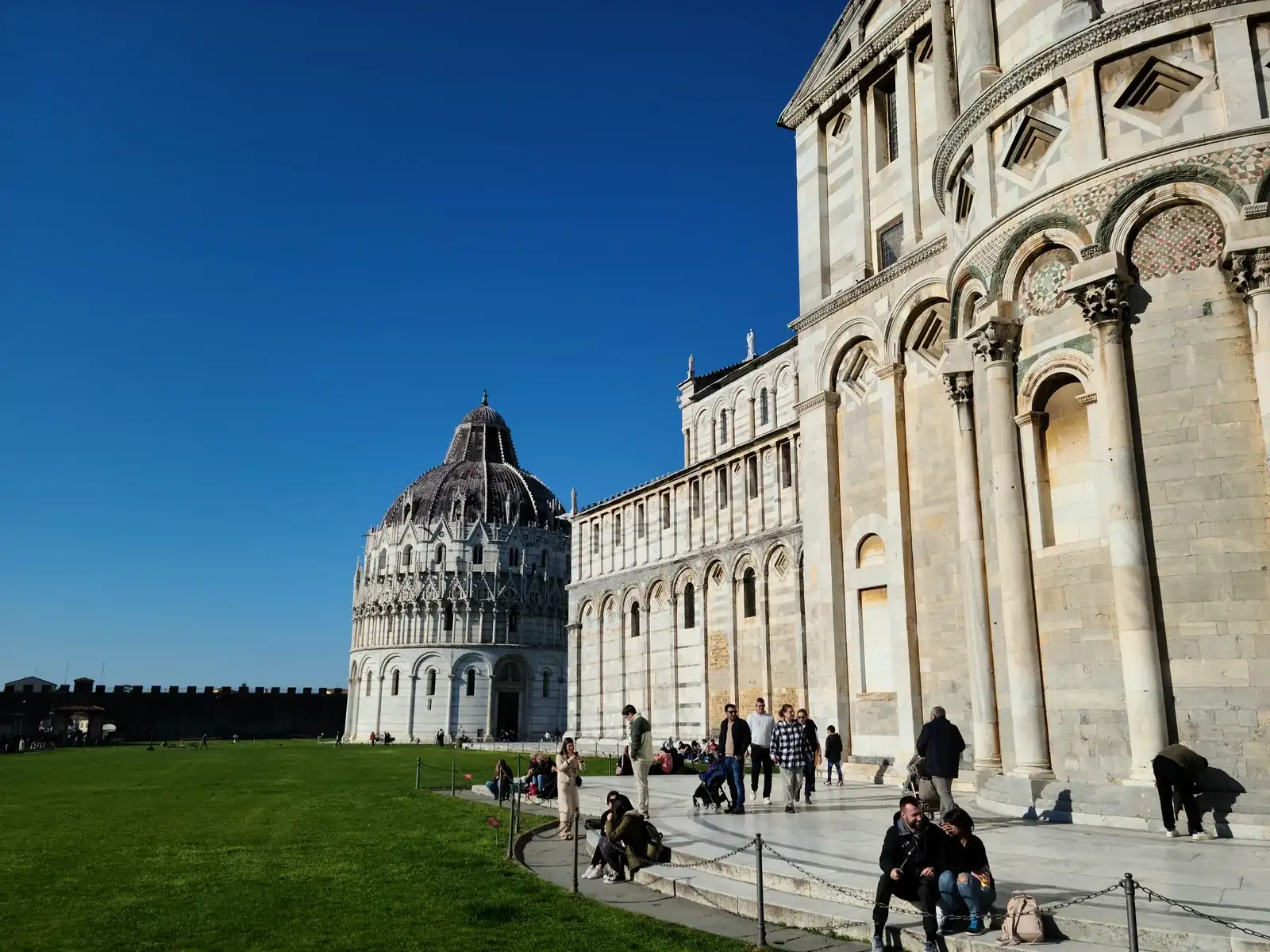
The Leaning Tower is the bell tower of the cathedral complex, not a fortification or standalone monument. Seven bells occupy the upper chamber, each tuned to a different musical note. According to the official Opera della Primaziale Pisana site, the tower stands 58.36 meters tall, has 273 steps, and currently tilts at 5.115°. Many travel guides use different numbers — those figures appear to come from older or secondary sources.
The tower climb ticket runs approximately €18 and includes cathedral access. Advance booking is strongly recommended, particularly in summer when availability runs out early in the day. Smaller crowds at the top are most likely during early morning or late afternoon slots.
Tower climb tickets frequently sell out before midday in peak season. Book online at the Opera della Primaziale Pisana website before your visit — the process takes about five minutes and removes all uncertainty about getting in.
Cathedral of Santa Maria Assunta
The Cathedral of Santa Maria Assunta is the anchor of the complex — a Romanesque structure with an interior that rewards slowing down. The bronzed doors, the mosaic work, and the arched ceilings are worth the time, but the fresco of the Assumption of Mary in the dome is the detail that tends to stop people mid-step. Access is often bundled with the tower ticket or available through a combo option.
Battistero di San Giovanni
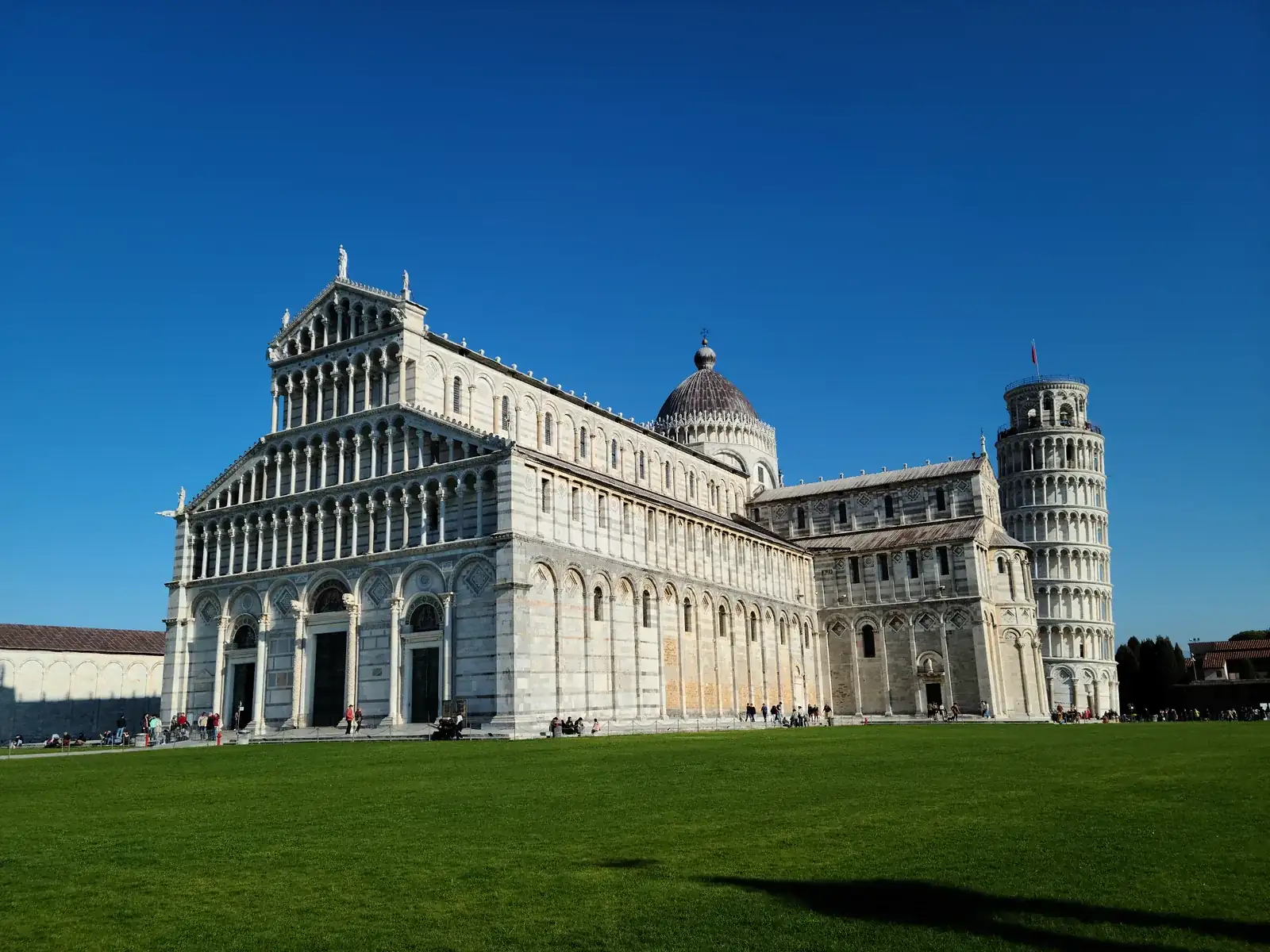
Italy’s largest Catholic baptistery sits at the western end of the square and blends Romanesque and Gothic architectural styles in a way that looks slightly different depending on where you stand. The architecture is worth a look, but the acoustics are the real reason to go inside.
Every half hour, an attendant demonstrates the echo in the circular space. The sound layers on itself and lingers in a way that’s hard to describe accurately and genuinely impressive in person.
The baptistery acoustic demonstration is one of the most memorable experiences in the square — arguably more so than the tower climb. Don’t skip it to spend more time at the tower base. It runs every 30 minutes; time your visit to catch it.
Camposanto Monumentale
The Camposanto is a monumental cemetery built around a Gothic cloister arcade, with marble burial markers, ancient sarcophagi, and fresco fragments that include the Triumph of Death. Located on the northern edge of the square, it is noticeably quieter than the area around the tower.
The contrast alone is worth the visit. The crowds that cluster around the tower base thin out almost entirely by the time you reach the cloister walk.
The Walking Route That Shows You the Real Pisa
The walk from Pisa Centrale to Piazza dei Miracoli is more than a commute to the monuments. Done in the right order, it moves through a genuine cross-section of how the city operates day to day — from a lived-in local district near the station to a medieval commercial street to a civic square that signals what Pisa actually is: a functioning university city, not a museum frozen around a tilted building.
San Martino
San Martino is the first neighborhood you pass through coming from Pisa Centrale, and it’s about as far from the monument lawn as you can get while still being close to it. Local shops, market energy, and a normal urban rhythm run through this district. Start here deliberately. Setting this baseline makes everything that follows land differently.
Ponte di Mezzo and the Arno Riverfront
Ponte di Mezzo is the central bridge connecting Pisa’s two riverbanks and leads directly into Borgo Stretto on the north side. The Arno riverfront — walkable along Lungarno Pacinotti, Lungarno Mediceo, and Lungarno Galilei — offers a slower version of the city than either the station district or the monument square.
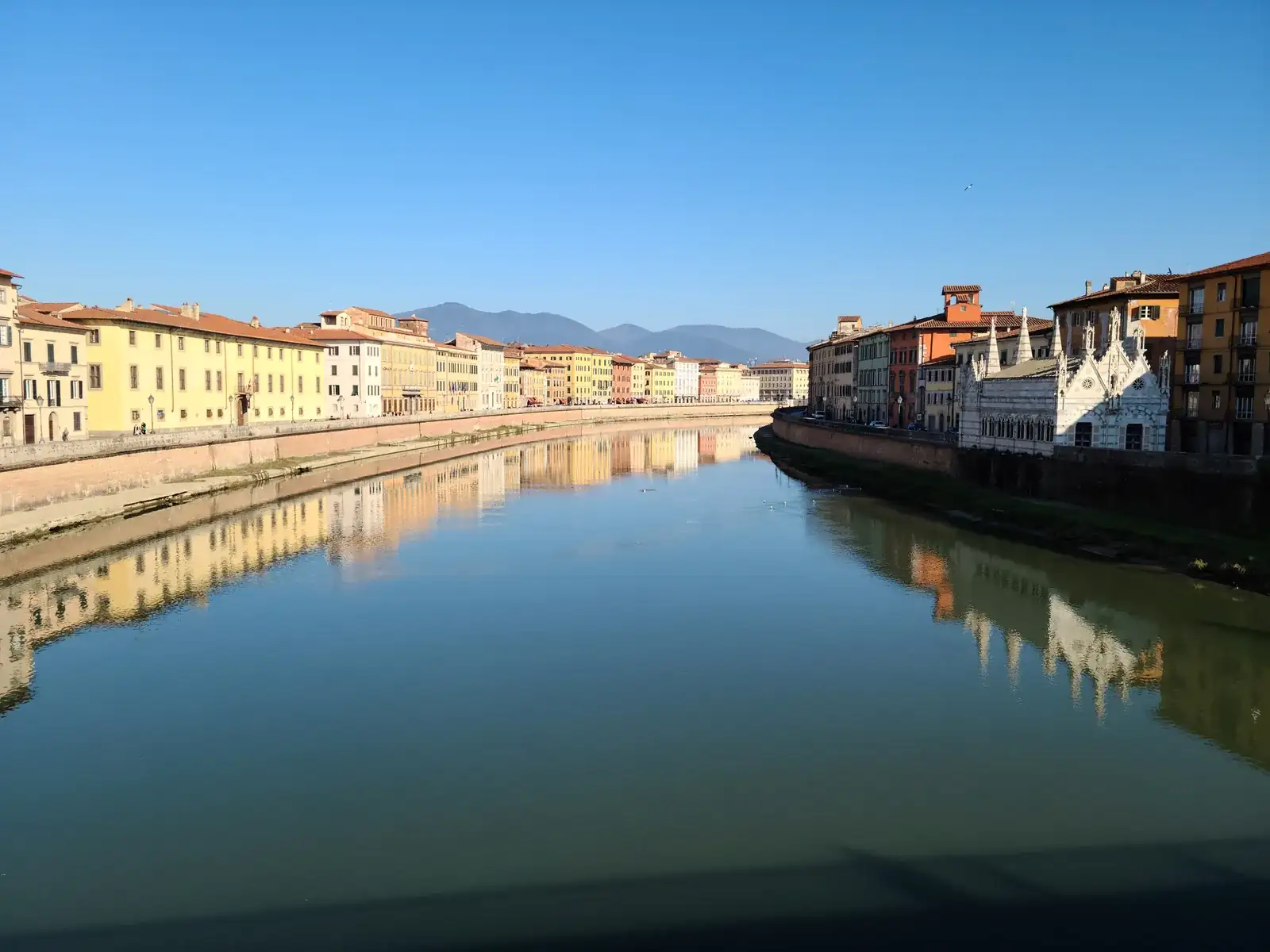
Visitors consistently describe the Lungarni as the stretch where Pisa starts to feel like a place worth spending time in rather than a destination to process and exit. Palazzo Blu, an art museum housed in a blue palazzo directly on the riverbank, is worth noting if there’s room in the schedule — it stages rotating exhibitions alongside its permanent collection.
Borgo Stretto
Borgo Stretto is a medieval pedestrian street running under covered arcades, lined with cafés and local shops. It functions as both a practical corridor and a destination in itself. Long stretches of it feel like they’re operating entirely for the residents who actually use it, which makes it a more comfortable walk than the area directly around the monuments.
Piazza dei Cavalieri
Piazza dei Cavalieri sits roughly halfway between Borgo Stretto and Piazza dei Miracoli. The Scuola Normale Superiore, one of Italy’s most selective universities, has its home here. Students cross this square to get to class. The city has its own life running in parallel to the visitor circuit, and Piazza dei Cavalieri is where that becomes obvious.
Pisa Sights Worth Adding If You Have Extra Time
If the morning route and Piazza dei Miracoli don’t fill the day, Pisa has several additional stops that hold up on their own.
The National Museum of San Matteo is the most substantial cultural stop outside the square. It houses medieval and Renaissance Pisan art and is specifically worth visiting for anyone who wants context for the Romanesque work they’ve just seen on the monument lawn.
The Orto e Museo Botanico is the oldest botanical garden in Italy, still run by the University of Pisa. A quieter stop that rewards a slow walk — the combination of working university institution and living historical garden gives it a character most tourist sites lack.
Tuttomondo, the Keith Haring mural on the rear exterior wall of Sant’Antonio Abate church, is a short walk from Pisa Centrale. Large-scale, visually loud, and completely at odds with the Romanesque stonework the rest of the city is built from — that contrast is the point. Tuttomondo is one of Haring’s last major works before his death in 1990 and worth finding even if street art isn’t usually your thing.
Piazza Chiara Gambacorti (also known as Piazza della Pera) is a local square with market vendors and aperitivo options that draws a noticeably different crowd than the tourist core. A good option for a late afternoon stop before dinner.
Where to Eat and Drink in Pisa on a One-Day Visit
Eating well in Pisa on a single day is mostly a matter of not defaulting to the restaurants clustered around Piazza dei Miracoli. The closer a restaurant is to the tower, the more likely it’s pricing for tourists who won’t be back.
For breakfast, Caffè Settimelli in the center is the straightforward starting point — a proper Italian café that doesn’t require much planning.
For lunch, Montino is the quick option: pizza by the slice and cecina, the Pisan chickpea flatbread that’s worth ordering specifically if you haven’t had it before. Filling, cheap, and fast. Numeroundici runs a seasonal daily-changing menu. Laboratorio Urbano Polpette takes a narrow focus on meatballs in several preparations including vegetarian. Al Madina handles Syrian-Lebanese food if the Italian rotation needs a break.
For the end of the day, Sottobosco pairs aperitivo with live music and works as an evening wind-down before catching a train out.
For gelato near the river: Gelateria De’ Coltelli uses seasonal ingredients and offers gluten-free and lactose-free options. Gelateria Tuffo 13 sits on the opposite bank with organic gelato and the same dietary accommodations.
Frequently Asked Questions
Can I see most of Pisa without renting a car, or is the city awkward on foot?
Pisa is genuinely one of the easier Italian cities to navigate without a car. Pisa Centrale station is the arrival point for Trenitalia regional trains — no advance booking required — and the entire recommended route from the station to Piazza dei Miracoli runs on foot. Taxis exist, but for the central area they’re unnecessary for most visitors. The city is compact enough that the main question isn’t how to get around, it’s how to sequence the stops.
Is the Leaning Tower worth booking in advance, or can I decide on the day?
Book in advance, especially if you’re visiting between June and September. The tower climb ticket is approximately €18 and includes cathedral access, and availability during peak season runs out faster than most visitors expect. Early morning or late afternoon slots tend to have smaller crowds at the top. Deciding on the day works in shoulder season, but it’s a gamble that isn’t worth taking when the booking process takes about five minutes.
What else is actually worth seeing in Pisa besides the tower and cathedral square?
Within Piazza dei Miracoli itself: the Battistero di San Giovanni for the acoustic demonstration, Camposanto Monumentale for the Gothic cloisters and medieval frescoes, and the Cathedral interior for the mosaic work and dome fresco. Beyond the square: Borgo Stretto, Piazza dei Cavalieri, the Arno Lungarni, Palazzo Blu, the National Museum of San Matteo, the Orto e Museo Botanico, the Tuttomondo mural near Pisa Centrale, and Piazza Chiara Gambacorti for a local square experience away from the tourist core.
How much time do you really need in Pisa if you’re not doing a rushed day trip?
The “one to two hours is enough” answer applies only to visitors limiting themselves to a photo at the tower base. A full day covers the Piazza dei Miracoli complex, the walking route through the city’s neighborhoods, the riverfront, and a meal — without rushing. Arriving specifically for the tower selfie and leaving works on its own terms, but that’s a different trip than this guide is written for.
Is Pisa just crowded tourist photos, or are there quieter neighborhoods worth lingering in?
The crowds concentrate almost entirely around the tower base. A short walk in any direction from that specific spot changes the experience considerably. San Martino and Borgo Stretto both have a local, lived-in character that feels nothing like the monument lawn. Piazza Chiara Gambacorti draws a neighborhood crowd rather than a tourist one. The Arno riverfront is consistently described as a slower, more local experience. Within the square itself, Camposanto Monumentale is noticeably quieter than the area around the tower. The crowded version of Pisa is a very small section of the actual city.